1. Kupu Whakataki
The KONNWEI RC-10 is a versatile 2-in-1 smart battery charger and pulse repair tool designed for a wide range of 12V and 24V batteries. It combines intelligent charging with advanced pulse repair technology to restore and maintain various battery types, including lead-acid (AGM, GEL, SLA, Flooded, EFB) and LiFePO4 lithium batteries. This manual provides essential information for the safe and effective operation of your RC-10 device.
The RC-10 is suitable for batteries in cars, trucks, SUVs, motorcycles, boats, and lawn mowers, offering both fast charging and battery restoration capabilities.

Whakaahua 1.1: The KONNWEI RC-10 Smart Battery Charger and Tester with its alligator clips.
2. Nga korero haumaru
Always prioritize safety when operating battery charging equipment. The KONNWEI RC-10 incorporates several safety features, but user adherence to safety guidelines is crucial.
- Pānuihia te pukapuka: I mua i te whakamahinga, pānuihia marietia, kia mārama hoki ki ngā tohutohu me ngā whakatūpato haumaru katoa kei roto i tēnei pukapuka.
- Whakahau: Me whakarite kia rawaka te hau i te wā e utu ana i ngā pākahiko, i te mea ka taea e rātou te whakaputa hau pahū.
- Parenga kanohi me te kiri: Wear appropriate eye protection (safety glasses) and protective clothing to prevent contact with battery acid.
- Ārai i ngā Korakora: Kaua e momi hikareti, kaua hoki e tukua kia pāngia e ngā korakora, e ngā mura rānei te taha o te pākahiko, o te rihi hiko rānei.
- Hononga Tika: Connect and disconnect the DC output clips only after setting the charger switch to the OFF position or unplugging the AC cord.
- Whakawhitinga Whakamarumaru Polarity: The RC-10 features reverse polarity protection. However, always double-check connections to ensure positive (+) is connected to positive and negative (-) to negative.
- Parenga werawera: The device is designed with overheat protection and a silent cooling fan. Avoid covering the charger during operation to ensure proper airflow.
- Parenga Awa Tuwera: Built-in overcurrent protection prevents damage from excessive current.
- Parenga-Poto: The charger includes short-circuit protection for enhanced safety.
- Voltage Stabilization: Ensures stable voltage output during charging.
- Fireproof Housing: The ABS housing is fireproof for added safety.

Whakaahua 2.1: Ka mutuview of the six safety protections integrated into the KONNWEI RC-10 charger.
3. Nga Hua o te Hua
The KONNWEI RC-10 is engineered with advanced features for efficient and safe battery management:
- Taumahinga 2-i-1: Combines a 12V 10A / 24V 5A intelligent battery charger with pulse repair technology.
- Hototahitanga Pūhiko Whānui: Supports lead-acid batteries (AGM, GEL, SLA, Flooded, EFB) and LiFePO4 lithium batteries, ranging from 4AH to 150AH.
- 7-StagTe Whakautu Aunoa: An intelligent algorithm ensures optimal charging, including Desulfation, Soft Start, Bulk Charge, Absorption, Battery Test, Recondition, and Float & Maintenance stages.
- Advanced Pulse Repair: Utilizes pulsed voltage and current to detect and repair sulfation and acid stratification, extending battery life by up to 50%.
- Tautuhi Aunoa: Automatically detects battery type (12V/24V) and adjusts charging current accordingly.
- Pūnaha Tiaki-maha: Includes overheat, overcurrent, reverse polarity, short-circuit, and voltage stabilization protection.
- Hoahoa Roa: Features a fireproof ABS housing, silent cooling fan, and ARM-controlled PCB for continuous, reliable operation.
- Utu Pawera: Automatically adapts charging parameters for optimal performance in both winter (below 10°C/50°F) and summer (above 28°C/82.4°F) conditions.

Whakaahua 3.1: The KONNWEI RC-10's dual functionality as a charger and pulse repair tool.

Whakaahua 3.2: The RC-10's all-in-one charging capabilities for various battery types and voltages.
4. Tatūnga me te Hononga
Follow these steps to properly set up and connect the KONNWEI RC-10 to your battery:
- Whakapaia te Pūhiko: Me whakarite kia ma nga pito o te pākahiko me te kore he waikura. Mena e tika ana, horoia ki te paraihe waea.
- Honoa te Whero Clamp: Whakauruhia te whero pai (+) clamp o te rihi ki te tauranga pai (+) o te pākahiko.
- Honoa te Black Clamp: Hono i te pango kino (-) clamp o te rihi ki te tauranga kino (-) o te pākahiko.
- Tūhono ki te Hiko: Plug the charger's AC power cord into a standard 110-220V electrical outlet.
- Rapu Aunoa: The RC-10 will automatically detect the battery type (12V or 24V) and display the current battery voltage and charging status on its screen.
Hiranga: Always connect the battery clamps before plugging the charger into the AC power outlet. Disconnect in reverse order: unplug AC power first, then remove the black clamp, and finally the red clamp.
5. Nga Tohutohu Whakahaere
5.1. Tīpakonga Aratau
The RC-10 features a one-key switch for selecting different charging modes. Press the "Mode" button to cycle through the available options:
- STD (Standard): Standard charging mode, suitable for general lead-acid batteries.
- AGM/GEL: Optimized for AGM, GEL, SLA, WET, DEEP CYCLE, EFB, Calcium, and similar lead-acid batteries.
- LiFePO4 (LF): Specifically for charging 14.8V LiFePO4 Lithium batteries or motorcycle Lithium batteries.
- MOTIPATIKA: Suitable for charging 6V motorcycle batteries.
- Whakatika: This mode is for battery maintenance or to rejuvenate aged batteries. It uses pulse technology to address sulfation and acid stratification. Not all batteries can be repaired.

Whakaahua 5.1: The RC-10's mode selection interface.
5.2. 7-Stage Te Tikanga Whakatau
The RC-10 employs a sophisticated 7-stage charging algorithm to ensure optimal battery health and charge efficiency:
- Desulfation: Breaks down battery sulfation to restore capacity. This stage uses high-frequency pulse charges.
- Te timatanga ngawari: A gentle power-up to protect sensitive or deeply discharged batteries.
- Akona Ake: Rapid charging to reach approximately 80% of the battery's capacity. The charger delivers maximum current during this stage.
- Te horomitanga: He taurite te voltage for a full charge, gradually reducing current as the battery approaches full capacity.
- Whakamātautau Pūhiko: Automatically evaluates the battery's health status to determine if further reconditioning is needed.
- Whakatikatika: If the battery test indicates, this stage applies pulse repair to revive aged cells and improve performance.
- Float & Maintenance: Long-term trickle charge to prevent self-discharge and maintain the battery at 100% charge without overcharging.
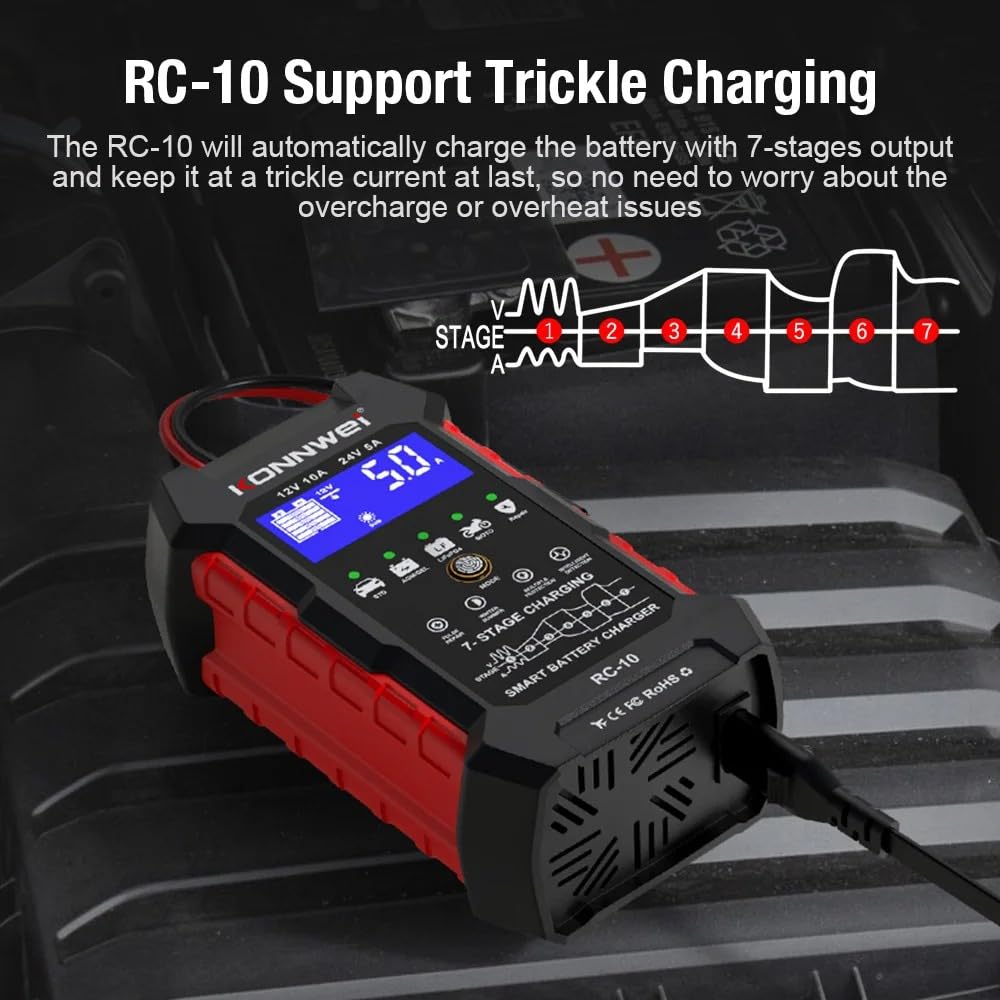
Whakaahua 5.2: Whakaahua o ngā 7-stage charging process and trickle charging support.
5.3. Pulse Repair Function
The dedicated "Repair" mode and the "Recondition" stage within the 7-stage process utilize advanced pulse technology to address common battery issues:
- Sulfation Removal: Detects and breaks down lead sulfate crystals that accumulate on battery plates, which is a primary cause of capacity loss.
- Acid Stratification Correction: Helps to mix the electrolyte, preventing acid from concentrating at the bottom of the battery.
This process can restore lost capacity and significantly extend the lifespan of aging batteries. Note that severely damaged or short-circuited batteries may not be repairable.

Whakaahua 5.3: The RC-10's battery repair function in action.

Whakaahua 5.4: Visual representation of the RC-10 detecting and addressing battery aging issues.
5.4. Utu Whakamahana
The RC-10 automatically adjusts its charging parameters based on ambient temperature to optimize charging efficiency and prevent over/undercharging:
- Aratau takurua: Activates automatically when the temperature is below 10°C (50°F), providing a higher charging voltage to compensate for increased battery resistance in cold conditions.
- Aratau Raumati: Activates automatically when the temperature is above 28°C (82.4°F), reducing charging voltage to prevent overcharging in warmer conditions.

Whakaahua 5.5: The RC-10's intelligent temperature compensation feature.
6. Tiaki
Proper maintenance of your KONNWEI RC-10 charger and the batteries it services will ensure longevity and optimal performance:
- Charger Cleaning: Keep the charger clean and dry. Wipe the casing me te ngohengohe, damp kakahu. Kaua e whakamahi i nga matū kino me nga horoi horoi.
- Tirohanga taura: Tirohia tonutia ngā taura utu me te whakamahanaamps mo nga tohu o te pakaru, te pakaru, te waikura ranei. Whakakapihia mehemea e tika ana.
- Rokiroki: Store the charger in a cool, dry place when not in use, away from direct sunlight and extreme temperatures.
- Tiaki Pūhiko: For batteries left connected for extended periods, the RC-10's float and maintenance mode will prevent overcharging and self-discharge. However, it is good practice to periodically check battery fluid levels for non-sealed lead-acid batteries.
7. Te Raru
If you encounter issues with your KONNWEI RC-10, refer to the following common troubleshooting tips:
- Karekau te Mihi e Whakaka ana:
- Ensure the AC power cord is securely plugged into a live outlet.
- Tirohia mehemea kei te mahi te putanga ma te hono atu ki tetahi atu taputapu.
- Karekau te pākahiko i te utu:
- Verify that the positive (+) and negative (-) clamps are correctly and securely connected to the battery terminals.
- Me whakarite te voltage is within the charger's operating range (12V or 24V).
- The battery might be severely discharged or damaged beyond repair. Try the "Repair" mode, but note that not all batteries can be revived.
- Error Message on Screen:
- If an error code or warning symbol appears, refer to the specific symbol's meaning (if provided on the device or in a more detailed manual). Common errors relate to reverse polarity, short circuits, or internal faults.
- Disconnect the charger from both AC power and the battery, wait a few minutes, and then reconnect.
- Te Wehana Rawa:
- Ensure the charger is in a well-ventilated area and its cooling fan is not obstructed.
- If overheating persists, disconnect immediately and contact customer support.
If these steps do not resolve the issue, please contact KONNWEI customer support for further assistance.
8. Whakatakotoranga
| Āhuahira | Whakatakotoranga |
|---|---|
| Tauira | RC-10 |
| Whakauru Voltage | 110-220V AC |
| Putanga Voltage (12V Mode) | 12V DC, 10A |
| Putanga Voltage (24V Mode) | 24V DC, 5A |
| Awhe Raukaha Raukaha | 4AH - 150AH |
| Momo Pūhiko Tautokohia | Lead-Acid (AGM, GEL, SLA, Flooded, EFB), LiFePO4 Lithium |
| Ka utaina a Stages | 7-Stage Automatic (Desulfation, Soft Start, Bulk Charge, Absorption, Battery Test, Recondition, Float & Maintenance) |
| Parenga Haumaru | Overheat, Overcurrent, Reverse Polarity, Short-Circuit, Voltage Stabilization, Overcharge |
| Te Waahi Mahi | Temperature compensated for optimal performance |
| Ahu (L x W x H) | 15.5 x 9.5 x 6 cm (6.1 x 3.7 x 2.4 inihi) |
| Taumaha | 0.5 kg (1.1 lbs) |
| Tiwhikete | CE, FCC, RoHS |
9. Pūtāhui me te Tautoko
For warranty information, technical support, or service inquiries regarding your KONNWEI RC-10, please contact KONNWEI customer service directly. Refer to the product packaging or the official KONNWEI webpae mo nga taipitopito whakapā o naianei.
Tena koa pupurihia to tohu mo te hoko mo etahi kereme whakamana.


