LILYGO T-Embed CC1101 Plus ESP32-S3 Development Board
Pukapuka Tohutohu
1. Nga korero haumaru
Please read this manual carefully before using the LILYGO T-Embed CC1101 Plus. This device is an electronic development board and should be handled with care. Improper use may result in damage to the device or personal injury.
Avoid exposure to water, moisture, or extreme temperatures.
Do not attempt to disassemble or modify the device beyond what is described in this manual.
Use only compatible power sources (USB Type-C) and accessories.
Kaua e taea e nga tamariki.
2. Ihirangi mokete
The LILYGO T-Embed CC1101 Plus package includes the following items:
1 x LILYGO T-Embed CC1101 Plus Development Board
1 x Pukapuka Kaiwhakamahi
Figure 2.1: LILYGO T-Embed CC1101 Plus package contents, including the device and user manual.
3. Hua Neke Atuview
The LILYGO T-Embed CC1101 Plus is a versatile development board featuring an ESP32-S3 microcontroller, a 1.9-inch IPS TFT LCD, and various wireless communication modules. Its compact design includes a transparent shell and a magnetic attraction design for easy assembly.
Whakaatu 3.1: Neke Atuview of the LILYGO T-Embed CC1101 Plus, highlighting key features like the ESP32-S3 MCU, wireless connectivity, transceivers, display, and power supply.
Figure 3.2: Detailed pinout diagram for the LILYGO T-Embed CC1101 Plus, showing connections for LCD, LORA, SD Card, Microphone, RGB LED, Encoder, PN532, and USB Type-C.
4. Tatūnga
4.1 Initial Setup and Assembly
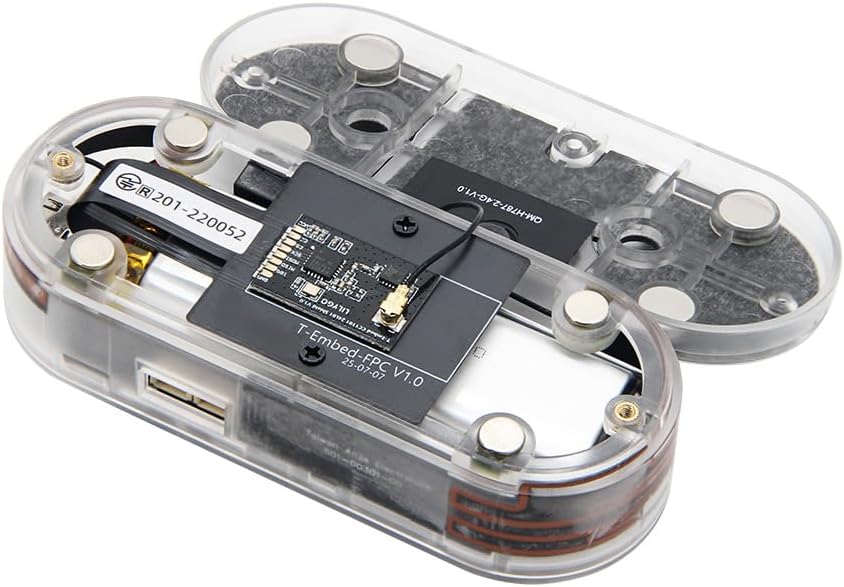
The LILYGO T-Embed CC1101 Plus comes with a transparent shell that uses a magnetic attraction design for easy assembly and disassembly. The device includes a built-in 1300mAh Li-Po battery.
Figure 4.1: The LILYGO T-Embed CC1101 Plus with its transparent shell disassembled, showing the internal components and battery.
4.2 Kei te Hiko / Weto
To power on the device, locate the power button on the board inside the shell. This may require removing the back cover. Once powered on, the device will boot up and display the user interface.
4.3 Mahi Taketake
The device features a round encoder with a button for navigation and interaction with the 1.9-inch IPS TFT LCD. Rotate the encoder to scroll through menus and press the button to select options.
Video 4.1: This video demonstrates the basic operation of the LILYGO T-Embed CC1101 Plus, including navigating the user interface, adjusting RGB LEDs, and using various functions like Sub-1G, NFC, Infrared, Music playback, and Microphone FFT.
5. Nga Tohutohu Whakahaere
5.1 Whakaterenga Atanga Kaiwhakamahi
Use the rotary encoder to navigate through the menus and select options. The 1.9-inch IPS TFT LCD provides visual feedback for all operations.
5.2 Hononga Ahokore
The device supports 2.4 GHz Wi-Fi and BLE 5. Access the 'Wireless' menu to configure Wi-Fi networks or manage Bluetooth connections.
5.3 Ngā Mahi a te NFC
The integrated PN532 NFC module allows for near-field communication. Access the 'NFC' menu to interact with NFC tags or devices.
5.4 Sub-1 GHz RF Transceiver (CC1101)
The CC1101 module enables Sub-1 GHz radio frequency communication. This can be used for various applications within its supported frequency bands (300-348 MHz, 387-464 MHz, 779-928 MHz).
5.5 Infrared (IR) Transceiver
The device includes IR TX and RX capabilities, allowing for infrared communication. This can be used for remote control applications or data transfer.
5.6 Purei Waiata
The device supports music playback. Ensure music files are in MP3 format and have English names for proper functionality.
5.7 Microphone FFT
The built-in microphone can be used for Fast Fourier Transform (FFT) analysis, allowing for visualization of audio waveforms.
6. Firmware Installation
The LILYGO T-Embed CC1101 Plus is an open-source development board. Firmware can be installed or updated using various development environments. The source code and 3D models are available on the official GitHub repository: github.com/Xinyuan-LilyGO/T-Embed-CC1101.
6.1 PlatformIO Installation/Burn
PlatformIO is a professional development environment for embedded systems. To install and burn firmware using PlatformIO:
Follow the instructions to add ESP32 board support to the Arduino IDE. This typically involves adding a board manager URL in preferences and installing the ESP32 boards package.
Download the T-Embed source code from GitHub.
Open the Arduino sketch (.ino) file from the downloaded source code in Arduino IDE.
Select the correct board (ESP32-S3 Dev Module) and COM port.
Upload the firmware to your device.
6.3 Micropython Installation/Burn
Micropython allows you to program the ESP32-S3 using Python. To install and burn Micropython firmware:
This involves installing prerequisites (Git, Python), getting ESP-IDF, and setting up the environment variables.
Download the T-Embed source code from GitHub.
Navigate to the project directory in your terminal.
Run `idf.py build` to compile the project.
Run `idf.py flash` to flash the firmware to your device.
Run `idf.py monitor` to view serial output.
7. Whakatakotoranga
Waehanga
Taipitopito
MCU
ESP32-S3 Dual-core LX7 microprocessor
Hononga Ahokore
2.4 GHz Wi-Fi, BLE 5
Whakawhiti
CC1101, PN532, nRF24L01
Whakaatu
1.9 inch ST7789V IPS TFT LCD
RAM
LPDDR4
Pūnaha Mahi
Linux
Taumaha Tūemi
4.9 hekere
Tae
Anga Puataata
8. Te Raru
Kaore te taputapu i te hiko: Ensure the battery is charged or the device is connected via USB-C. Check the internal power button.
Firmware upload issues: Verify that all drivers are installed correctly and the correct board and COM port are selected in your IDE. Ensure the device is in download mode if required.
Ngā raruraru hononga ahokore: Check Wi-Fi credentials and ensure the device is within range of the network. For Bluetooth, ensure the device is discoverable.
Whakaatu kaore e mahi: Ensure the display ribbon cable is securely connected.
9. Pūtāhui me te Tautoko
LILYGO provides product service and support. If you have any questions or suggestions about the product, please feel free to contact us. We will answer your question as soon as possible.
For further assistance, please refer to the official LILYGO webpae, whakapā atu ranei ki te tautoko a te kaihoko.
Tuhinga e pa ana - T-Embed CC1101 Plus
LILYGO T-Whakamaua te Aratohu Kaiwhakamahi He aratohu kaiwhakamahi matawhānui mo te poari whanaketanga LILYGO T-Embed, e hipoki ana i te tatūnga, te whakauru Arduino IDE, me te tohutoro whakahau Wi-Fi.
LILYGO T-BEAM-S3 Aratohu Kaiwhakamahi: Tatūnga me te Whanaketanga Ko tenei aratohu kaiwhakamahi e whakarato ana i nga tohutohu matawhānui mo te whakarite i te papa whanaketanga LILYGO T-BEAM-S3. Akohia me pehea te whirihora i te taiao rorohiko ma te whakamahi i te Arduino IDE, te hono i te poari, me te whakamahi i ona kaha Wi-Fi, BLE, GPS, me te LoRa mo nga kaupapa IoT.
LILYGO T-Whakaatu-S3 Aratohu Kaiwhakamahi He aratohu kaiwhakamahi mo te poari whanaketanga LILYGO T-Display-S3, e hipoki ana i te tatūnga, te whakamahi Arduino IDE, me nga whakahau Wi-Fi taketake.
LILYGO T-QT Pro Aratohu Kaiwhakamahi He aratohu kaiwhakamahi matawhānui mo te poari whanaketanga LILYGO T-QT Pro, e whakaatu ana i te tatūnga, te whirihoranga, me te whakamahinga me te Arduino me te ESP32-S3.